
Key points
- Employee share 0.75%, employer share 3.25% of gross wages — 4% in total.
- Coverage applies when gross wages are ₹21,000 a month or less (₹25,000 for persons with disability).
- Two contribution periods a year: April–September and October–March. Once covered, contributions continue till the period ends.
- Pay the monthly contribution by the 15th of the following month.
Key facts (as of 13 November 2026)
- Rates: employee 0.75%, employer 3.25% of wages, since 1 July 2019 (ESIC).
- Wage limit: ₹21,000 a month, ₹25,000 for persons with disability (ESIC).
- Employees with an average daily wage up to ₹176 do not pay the employee share; the employer still pays 3.25% (ESIC).
- ESI now runs under the Code on Social Security, 2020, in force from 21 November 2025 (PIB).
Updated 13 November 2026. Try the free ESI calculator.
What is ESI?
The Employees' State Insurance (ESI) scheme, run by the Employees' State Insurance Corporation (ESIC), gives covered employees and their dependants medical care and cash benefits during sickness, maternity, disablement and employment injury, plus dependants' benefit in case of death due to employment injury. It is funded by a monthly contribution shared between employer and employee.
ESI now applies under the Code on Social Security, 2020, which replaced the ESI Act, 1948 from 21 November 2025. It covers establishments with 10 or more employees in areas notified by ESIC; coverage has been extended district by district and now reaches most of India, so check that your location is notified. Once your establishment is registered, every eligible employee must be registered and contributed for from the date of joining.
What is the ESI contribution rate?
4% of gross wages in total: the employee pays 0.75%, deducted from salary, and the employer pays 3.25% on top. These rates have applied since 1 July 2019. Employees whose average daily wage is up to ₹176 pay nothing, but the employer still pays its 3.25%.
| Contributor | Rate | Base |
|---|---|---|
| Employee | 0.75% | Gross wages for the month |
| Employer | 3.25% | Gross wages for the month |
| Total | 4.00% |
These rates have applied since 1 July 2019. ESIC exempts employees whose average daily wage is up to ₹176 from paying the employee share; the employer still pays its 3.25% for them. Check esic.gov.in for changes as the transition to the Code on Social Security completes.
What is the ESI wage limit?
₹21,000 a month of gross wages, or ₹25,000 for persons with disability. An employee within the limit at the start of a contribution period, or on joining, is covered for that whole period. So ESI applies on an ₹18,000 salary, but not to a new joiner on ₹35,000.
An employee is covered when their gross wages are ₹21,000 per month or less. For persons with disability the ceiling is ₹25,000 per month. Unlike PF, there is no cap on the contribution base: if an employee is covered, ESI is calculated on the full gross wages for the month.
Coverage is decided at the start of each contribution period, or on joining for a new employee, based on the wages at that time.
Contribution periods and the continuation rule
| Contribution period | Corresponding benefit period |
|---|---|
| 1 April – 30 September | 1 January – 30 June (following year) |
| 1 October – 31 March | 1 July – 31 December |
The important rule for payroll is continuation: if a covered employee gets an increment in, say, July that takes their wages above ₹21,000, you keep deducting ESI on their actual wages until 30 September. From 1 October they fall outside coverage (unless their wages come back within the limit). The same applies within the October–March period, ending 31 March.
What counts as wages for ESI
For ESI, "wages" broadly means all remuneration paid or payable in cash for the month: basic, DA, HRA, special and other allowances, and incentives paid monthly. Items generally excluded include the employer's contributions to PF or pension, gratuity payable on discharge, retrenchment compensation, and sums paid to meet special expenses such as travel reimbursements.
Overtime
Overtime wages are included when calculating the contribution for the month, but overtime is not considered when checking whether the employee is within the ₹21,000 coverage limit. So an employee on ₹20,000 gross who earns ₹3,000 overtime stays covered, and ESI is calculated on ₹23,000 that month.
How do I calculate ESI from my salary? (₹18,000 example)
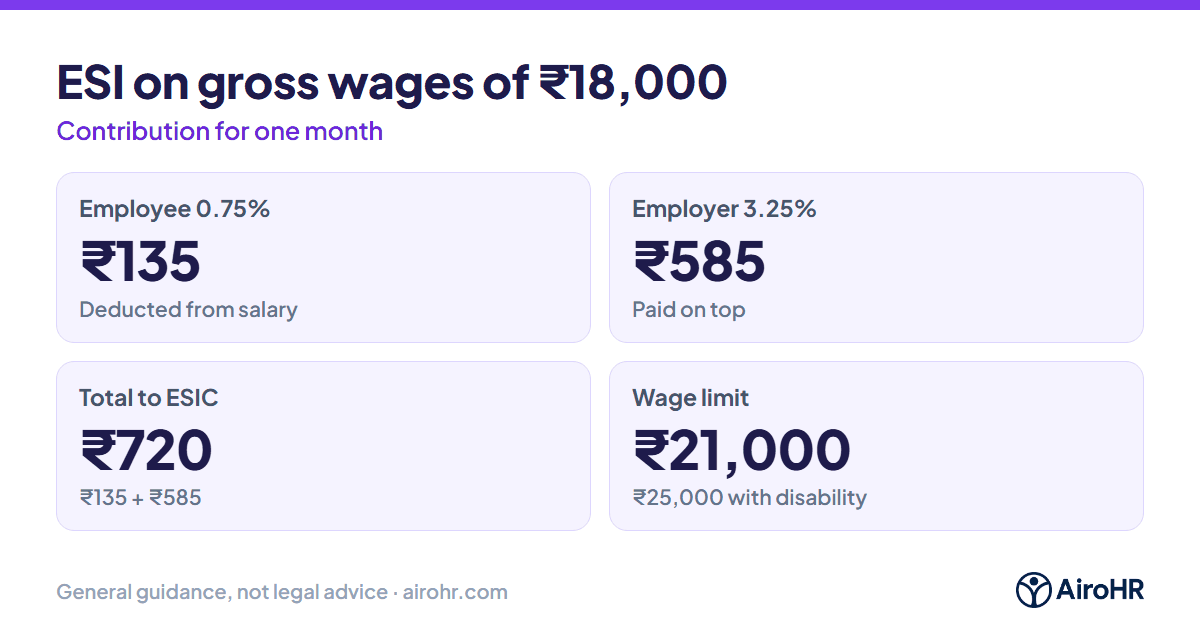
Take the gross wages earned in the month, including overtime. Multiply by 0.75% for the employee's deduction and by 3.25% for the employer's share, and round each up to the next rupee. For ₹18,000 gross: ₹135 deducted from salary, ₹585 paid by the employer, ₹720 paid to ESIC.
An employee earns a gross salary of ₹18,000 a month (Basic ₹9,000, HRA ₹3,600, other allowances ₹5,400). They are within the ₹21,000 limit, so ESI applies.
| Item | Calculation | Amount |
|---|---|---|
| Gross wages for ESI | — | ₹18,000 |
| Employee share (deducted from salary) | 0.75% × ₹18,000 | ₹135 |
| Employer share (paid on top) | 3.25% × ₹18,000 | ₹585 |
| Total remitted to ESIC | ₹135 + ₹585 | ₹720 |
Now suppose the same employee works overtime worth ₹1,500 in a month. ESI wages become ₹19,500:
- Employee share: 0.75% × ₹19,500 = ₹146.25, rounded up to ₹147
- Employer share: 3.25% × ₹19,500 = ₹633.75, rounded up to ₹634
ESI contributions are rounded up to the next whole rupee. If the employee had loss-of-pay days, ESI is calculated on the wages actually earned for the month, not the full monthly salary.
ESI calculated in every payroll run
AiroHR re-tests the ESI wage limit for each employee in every payroll month, includes overtime in the contribution base, and produces ESIC reports ready for upload on the ESIC portal. If an employee's wages cross the limit mid-period, HR keeps ESI on to the end of the contribution period by switching off that employee's ESI wage-limit check in their deductions settings.
PF & ESI software Request free trialWhen is the ESI contribution due?
By the 15th of the following month. The employer deducts the employee's 0.75% from salary and pays it with the employer's 3.25% through the employer login on the ESIC portal, so September wages are due by 15 October. Late payment attracts interest and can lead to damages.
The employer deducts the employee share from salary and pays both shares together through the employer login on the ESIC portal. The monthly contribution is due by the 15th of the following month — September wages by 15 October. Delays attract interest and can lead to damages, and employees may face issues availing benefits if contributions are missing.
Monthly ESI checklist
- Register new joiners on the ESIC portal and give them their IP (insurance) number.
- Confirm who is covered for the current contribution period — do not drop anyone mid-period.
- Lock attendance so that paid days and overtime are final.
- Calculate 0.75% and 3.25% on the month's ESI wages, rounded up.
- Upload monthly contributions and pay the challan before the 15th.
ESI is usually filed alongside PF. See our PF ECR filing guide for the EPFO side, and the salary slip format guide for showing ESI correctly on payslips.
Stop calculating statutory deductions in Excel
PF, ESI and state-wise Professional Tax are calculated, and the monthly TDS you set is deducted, in every AiroHR payroll run, straight from kiosk, mobile or imported biometric attendance. From ₹49 per employee per month.
Payroll software See pricingOfficial sources
- ESIC: contribution rates and periods — Employees' State Insurance Corporation
- Government makes the four Labour Codes effective — Press Information Bureau, 21 November 2025
- Employees' State Insurance Corporation (circulars and coverage notifications)
Work it out, then stay up to date
Use the free esi calculator, or get each month's PF, ESI, PT and TDS dates by email with free compliance alerts.
Related guides
This article is general guidance, not legal or tax advice. ESI rates, wage limits and coverage are set by notification — always confirm current rules on the official ESIC website. Last reviewed: 13 November 2026.